Ad

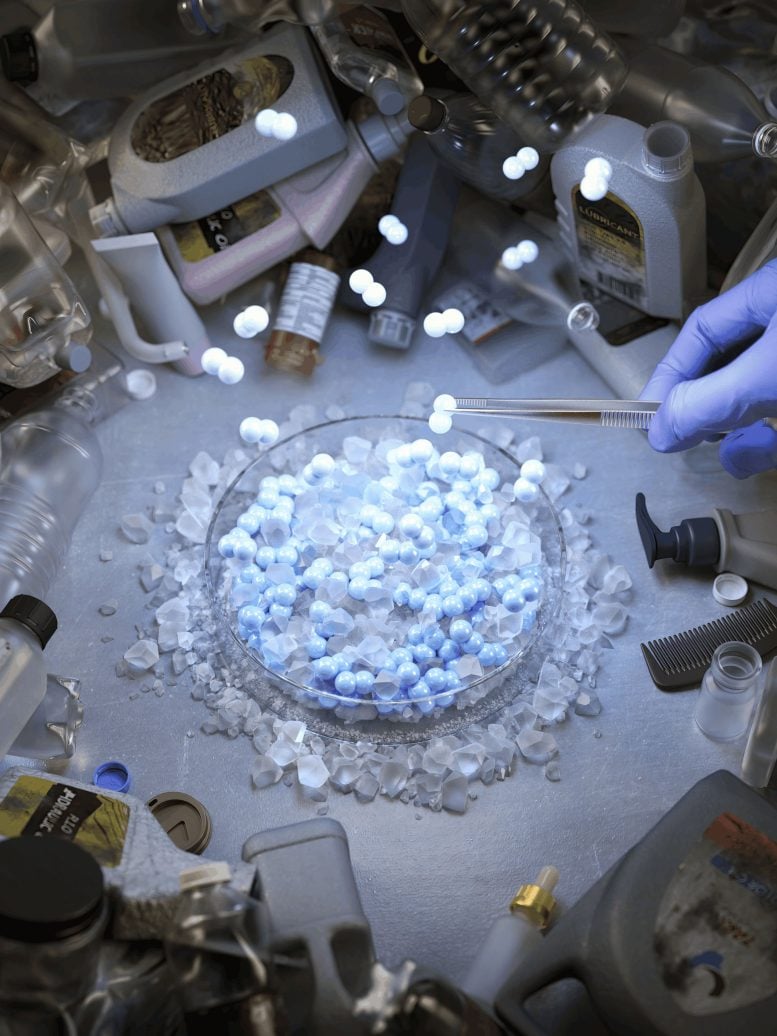 An illustration of a thermal treatment process that transforms heterogeneous plastic waste into a biomass-like hydrogen source, enabling hydrogen production without carbon dioxide emissions. Credit: Younghee Lee/CUBE3D Graphic
The advance could provide a scalable route to clean energy while making plastic recycling more effective.
A discarded bottle, shopping bag or car part can remain in the waste stream long after its useful life ends. Although plastic is everywhere in modern society, recycling it remains difficult because most systems require different types to be separated first, an expensive and labor-intensive step.
As a result, only 9% of plastic waste is recycled, while 79% goes to landfills and 12% is burned, releasing carbon dioxide.
Mixed plastics become clean hydrogen
Researchers co-led by the UCLA Samueli School of Engineering and Ewha Womans University in South Korea have demonstrated a chemical process that converts a mixture of three widely used plastics into high-purity hydrogen fuel. The method operates at substantially lower temperatures than conventional gasification and stores the carbon as a solid mineral instead of releasing carbon dioxide into the atmosphere.
The findings, published in Proceedings of the National Academy of Sciences, center on alkaline thermal treatment (ATT), in which heated sodium hydroxide reacts with organic material to produce hydrogen. In a single reactor, the process treated mixed polyethylene terephthalate (PET), polyethylene (PE), and polypropylene (PP) without requiring the plastics to be sorted first. The resulting hydrogen exceeded 90% purity.
“We are solving two urgent global problems at the same time,” said co-corresponding author Ah-Hyung “Alissa” Park, the Ronald and Valerie Sugar Dean of UCLA Samueli and a professor of chemical and biomolecular engineering. “Plastic waste is accumulating at alarming rates, and clean hydrogen is essential for decarbonizing energy. This technology tackles both of these challenges in a creative and scalable way.”
Park and study co-corresponding author Woo-Jae Kim, a professor of chemical engineering and materials science at Ewha Womans University, originally developed ATT as a carbon-neutral way to turn biomass such as seaweed into hydrogen gas. The researchers adapted that method for plastic waste and used it in laboratory tests on PET, PE, and PP. It generated considerably more hydrogen from PET while running at temperatures 300-400 degrees Celsius below those required for traditional steam gasification.
Mild heating unlocks stubborn plastics
Polyethylene and polypropylene initially produced less hydrogen than PET because their structures consist entirely of stable carbon-hydrogen bonds that respond poorly to alkaline treatment.
To make the plastics reactive, the researchers added a thermal oxidation pretreatment that briefly heats them in air before the main reaction. This introduces oxygen-containing functional groups along the polymer chains, forming chemical sites that sodium hydroxide can attack.
Most carbon stays out of the air
After this activation step, all three plastics broke down efficiently. Sodium hydroxide captured carbon released during the reaction and converted it into solid sodium carbonate rather than allowing it to escape as carbon dioxide. Analysis after treatment found that more than 75% of the plastics’ original carbon remained in stable carbonate or liquid organic residues. Less than 13% entered the gas phase, and the reaction released negligible carbon directly into the atmosphere.
A straightforward recovery process can then transform the sodium carbonate into calcium carbonate, permanently storing the carbon in a mineral commonly used by industries that have traditionally produced large carbon emissions.
Earlier low-temperature methods for producing hydrogen from plastic waste have faced major restrictions. Solar-driven photoreforming and electrochemical conversion generally work only with oxygen-containing plastics such as PET, excluding polyethylene and polypropylene even though both are abundant in discarded plastic. Conventional high-temperature gasification can process unsorted mixtures, but it produces substantial carbon dioxide emissions. This is the first use of the researchers’ ATT method designed to overcome all three problems together.
Commercial scale remains unproven
“By reducing the sorting costs and process complexity that have been major barriers to commercialization, this technology has the potential to become a next-generation core technology that supports both the hydrogen economy and the circular economy,” Kim said.
Before the process can be used at commercial scale, the researchers must further improve its performance and determine whether it is economically practical.
Reference: “Selective and direct hydrogen generation from mixed plastic waste via alkaline thermal treatment with inherent carbon storage” by Jieun Park, Hyunah Kim, Hyerin Seo, Jiwon Lee, Hyung-Kyu Lim, Wonho Jung, Ah-Hyung Alissa Park and Woo-Jae Kim, 6 July 2026, Proceedings of the National Academy of Sciences.
DOI: 10.1073/pnas.2537552123
The research was supported by the National Research Foundation of Korea.
Never miss a breakthrough: Join the SciTechDaily newsletter.
Follow us on and Google News.
Ad
